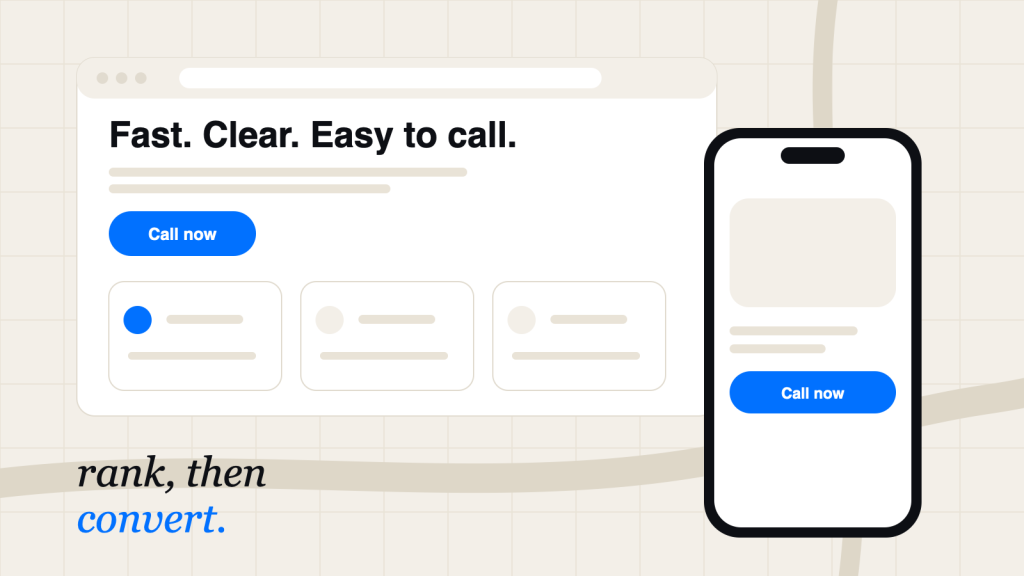
A small business website needs five things to rank and convert: clear pages for each service and location, fast loading on a phone, visible proof that you are real and trusted, an easy way to call or book, and a clean technical foundation that search engines can read. Skip any of these and you lose visitors or never get found in the first place. Here is a practical checklist.
Pages every local business site needs
A site does not need dozens of pages. It needs the right ones, each with a purpose.
A home page that explains who you help
Within a few seconds, a visitor should know what you do, where you do it and what to do next. Put your main service, your area and a call or booking button at the top. Everything else supports that.
One page per core service
If you offer drain cleaning, water heater installation and repiping, each deserves its own page. A single “Services” page with a bulleted list gives search engines little to rank and gives visitors little to trust. Each service page should explain the problem, what you do, how the process works, who it is for and what happens next. Write it the way you would explain it to a client at the counter.
Location pages, only where you really work
If you serve several towns, a page for each can help, but only if each page has real information about that area: the neighborhoods you cover, the kinds of jobs you do there, and anything that makes it genuinely local. Pages that swap only the town name read as thin, and visitors notice. If you only serve one city, put that city clearly on your service pages instead.
About, contact and reviews
People check who is behind a business before they call. An about page with your real story, your real team and your licenses or credentials builds trust. A contact page with your address, phone, hours and a short form gives people every option. Keep your name, address and phone number identical to your Google Business Profile.
Speed and mobile experience
Most local searches happen on a phone, often by someone in a hurry. If your site is slow or awkward on a small screen, they leave. You do not need to guess: open your site on your own phone, on mobile data, and try to complete the action a client would. Check that:
- The page appears quickly and does not jump around as it loads.
- Text is readable without zooming.
- Buttons are big enough to tap and not crowded together.
- The phone number is tappable and the form is short.
Oversized images are the most common cause of slow pages. Resize and compress photos before you upload them, and avoid heavy sliders and autoplay video above the fold.
Make it easy to take the next step
Every page should have one main action. For a local business that is usually a call, a booking or a quote request. Put it where people can see it without scrolling and repeat it after each major section.
- Click-to-call button in the header on mobile.
- Short form asking only what you need: name, contact details and what they need. Every extra field loses some people.
- Clear button text such as “Book an appointment” or “Get a quote” instead of “Submit”.
- Hours and response time so people know when to expect an answer.
Then make sure someone responds. A site that generates inquiries nobody answers is a leak. See our notes on lead management for ways to keep every inquiry in view.
Show proof that you are real
Trust decides whether a stranger picks you. Add proof that is true and checkable:
- Reviews from real clients, ideally pulled from your Google Business Profile.
- Photos of your own work, team and location, not stock images.
- Licenses, insurance, certifications and memberships you actually hold.
- Clear policies on pricing, warranties and how you work.
Never fabricate testimonials or badges. If you do not have many reviews yet, build them honestly first. Our guide to reviews and reputation shows how.
What search engines need to read
Good content still needs a sound foundation. A few technical basics make a real difference for local sites:
- Unique title and description for each page that include the service and the place, written for people.
- One H1 per page that states what the page is about, then logical H2 and H3 headings.
- HTTPS across the whole site.
- A sitemap and a working robots file so search engines can find your pages.
- Descriptive image names and alt text that describe the photo.
- Structured data for your business, such as LocalBusiness markup with your name, address, phone and hours.
- Clean internal links between related pages, for example from a service page to its related service.
None of this is magic. It makes your pages easier to understand, which helps them compete. Our local SEO work covers these foundations together with your Google Business Profile and citations.
Tie your site to your Google Business Profile
For local searches, your website and your profile work as a pair. Link your profile to the most relevant page, usually the home page or a booking page. Match your name, address, phone and categories. Show the same hours on both. Mismatches confuse people and weaken trust. If you manage the profile yourself, see our guide on Google Business Profile management.
Measure what the site does
A website you cannot measure is a guess. At minimum, set up tracking for calls, form submissions and booking clicks. Then look at it monthly, and ask:
- Which pages bring in visitors?
- Which pages lead to a call or form?
- Where do people drop out?
Small changes often help: moving the button higher, shortening the form, rewriting a headline so it says what you do. Change one thing at a time so you can tell what worked. Our marketing analytics service sets up the dashboard so you do not have to dig for it.
A quick audit you can do today
- Open your site on your phone and try to call or book in under ten seconds.
- Check that each main service has its own page with real detail.
- Confirm your name, address and phone match your Google Business Profile exactly.
- Look for real photos and real reviews on the pages that matter.
- Test your form and your phone number to make sure they actually reach you.
- Search your business name and main service plus your city, and see what appears.
When to fix it and when to rebuild
If the structure is sound, you can improve a site in pieces: better pages, faster images, stronger calls to action. If the site is built on something outdated, cannot be edited easily, or does not work on phones, a rebuild may cost less than endless patching. Our website development projects include tracking and Google Business Profile setup so the new site is ready to be found.
Not sure which side of that line you are on? Talk to USM and we will give you an honest view of what your site needs.