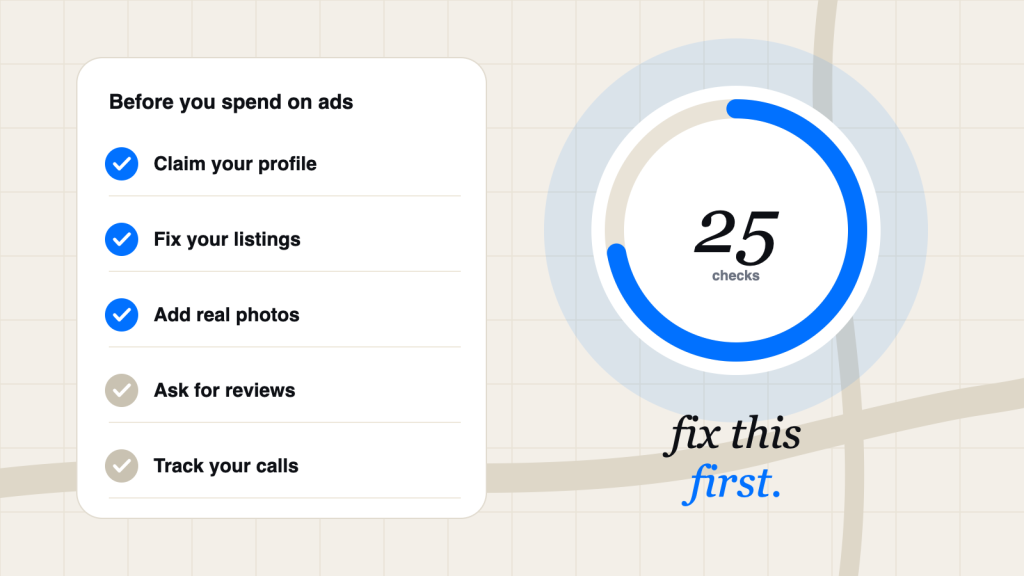
Before you spend on ads, make sure the free foundations are in place: a complete Google Business Profile, consistent listings, a website that is fast and clear on a phone, services pages with local detail, a steady review routine and tracking that tells you where clients come from. Ads multiply whatever you already have. If your profile and site are weak, ads multiply the weakness. Here is a 25-item checklist, grouped so you can work through it in an afternoon and then keep improving.
How to use this checklist
Go through it once and mark each item as done, partly done or missing. Fix the missing ones in the order they appear, because the earlier items affect the later ones. Do not worry about perfection. A business that completes most of these will usually be in better shape than competitors who skip them.
Google Business Profile (items 1 to 8)
- 1. Claimed and verified. You control the profile with an account you own.
- 2. Real business name. No added keywords or locations.
- 3. Accurate primary category. The most specific one that fits.
- 4. Relevant secondary categories. Only for services you really offer.
- 5. Hours and holiday hours correct. Check them against reality.
- 6. Services listed with short descriptions. Use client language.
- 7. Real photos. Exterior, interior, team and finished work, added regularly.
- 8. Correct address or service area. No P.O. boxes or virtual offices.
If several of these are missing, start with our Google Business Profile optimization guide.
Reviews (items 9 to 12)
- 9. A direct review link. Copied from your profile and tested on a phone.
- 10. A routine for asking. Every client, soon after a good experience.
- 11. Replies to all reviews. Good and bad, written by a human.
- 12. No rule-breaking. No paid reviews, no incentives, no fake accounts.
Review requests are explained in how to get more Google reviews.
Listings and consistency (items 13 to 16)
- 13. Same name, address and phone everywhere. Google, Apple Maps, Bing, Yelp and your site.
- 14. No duplicates. One listing per location on each platform.
- 15. Industry directories. Claimed where clients in your trade look.
- 16. Old information removed. Former addresses, closed locations and old numbers.
We explain the process in local citations and NAP consistency, and our local listings service handles it for you.
Website (items 17 to 22)
- 17. Mobile-friendly. Test on your own phone, on mobile data.
- 18. Loads quickly. No heavy sliders or giant images.
- 19. A page for each main service. With details, not one-line lists.
- 20. Local detail. Your service area, nearby landmarks or neighborhoods, and real project examples.
- 21. Clear contact options. Tap-to-call, a short form and your address in text.
- 22. Secure and working. HTTPS, no broken pages, forms that actually deliver messages.
Test your forms by submitting one yourself. It is surprising how many silently fail. If the site needs a rebuild, see website development.
Tracking (items 23 to 25)
- 23. Call tracking or call logging. So you can tell which calls came from ads and which from search.
- 24. Form and booking tracking. Each submission recorded with its source.
- 25. A “how did you hear about us?” question. Asked on forms and by phone, with answers written down.
Without tracking, you will not know whether ad spend is working. Our marketing analytics service sets this up properly.
Why these come before ads
Paid clicks cost money every time. If someone clicks your ad and lands on a slow page with no clear next step, you have paid for a visitor who leaves. If they search your name and find three reviews from 2019 and the wrong phone number, they will call someone else. Fixing the foundations first means every ad dollar has a better chance of turning into a client.
It also helps with the ad platforms themselves. Google Ads and Local Services Ads both rely on accurate business information, and Local Services Ads in particular depend on your reviews and responsiveness.
Quick wins you can finish this week
- Correct hours and categories on your Google profile.
- Copy your review link and send it to your last five happy clients.
- Find and fix one wrong listing.
- Test your website form and your phone number.
- Add three real photos to your profile.
Slower jobs that are worth starting
- Writing a full page for each service.
- Collecting reviews steadily over months.
- Earning local mentions and links from chambers, partners and local organizations.
- Producing real photo and video content.
How to know you are ready for ads
You are probably ready to spend when:
- Your profile is complete and your reviews are recent.
- Your website works on a phone and has a clear way to contact you.
- You can track calls and forms.
- You know your average job value, so you can work out what a new client is worth to you.
- Someone will answer the phone or reply promptly.
When you reach that point, Google Ads or Local Services Ads are common places to start. Set a fixed monthly budget, run it for long enough to learn something, and compare booked jobs with cost, not only clicks.
One more thing: capacity
Marketing is only useful if you can serve the clients it brings. If your schedule is already full, adding ads will only push people to waiting lists or rushed service. Check your capacity before you increase demand.
A note on priorities
Not all 25 items carry equal weight. If time is short, do these first: a verified profile with correct categories and hours, a working phone number, a mobile-friendly site with a visible contact option, and a review request routine. Those four prevent the most wasted spend. The rest improve your results gradually. Treat the checklist as a living document and revisit it every quarter, because hours change, staff change, listings drift and sites break without anyone noticing.
How to run the checklist with your team
Print or copy the list and assign each section to the person closest to it. The office manager can own hours, listings and the phone. A technician or front desk lead can own photos and review requests. Whoever manages the website owns speed, forms and service pages. Meet for twenty minutes, agree on deadlines and check back in two weeks. Shared ownership prevents the list from becoming one person’s forgotten project.
Want a second pair of eyes?
If you went through this list and found a long set of gaps, or you are not sure how to fix them, talk to us at USM. We will help you decide what to repair first and whether paid advertising makes sense for your business right now.